
Tests and Evidence
Check one period of work and save the material supporting your conclusion.
A Test describes a repeatable check of a Control. Evidence is the material reviewed to support the conclusion.
Suppose the support team requires approval before sensitive account changes. A useful Test checks the team's changes for a month and verifies that each included request has its required approval. The request list and review records are supporting Evidence. Use this flow when you need to show that a documented practice actually worked during a particular period.
Check one period of human reviews
1. Open the Control and define the check
From the active Framework's Controls, open the relevant Control's Tests and Evidence. This keeps the check connected to the obligation you are investigating. You can also reach it from the Control itself.
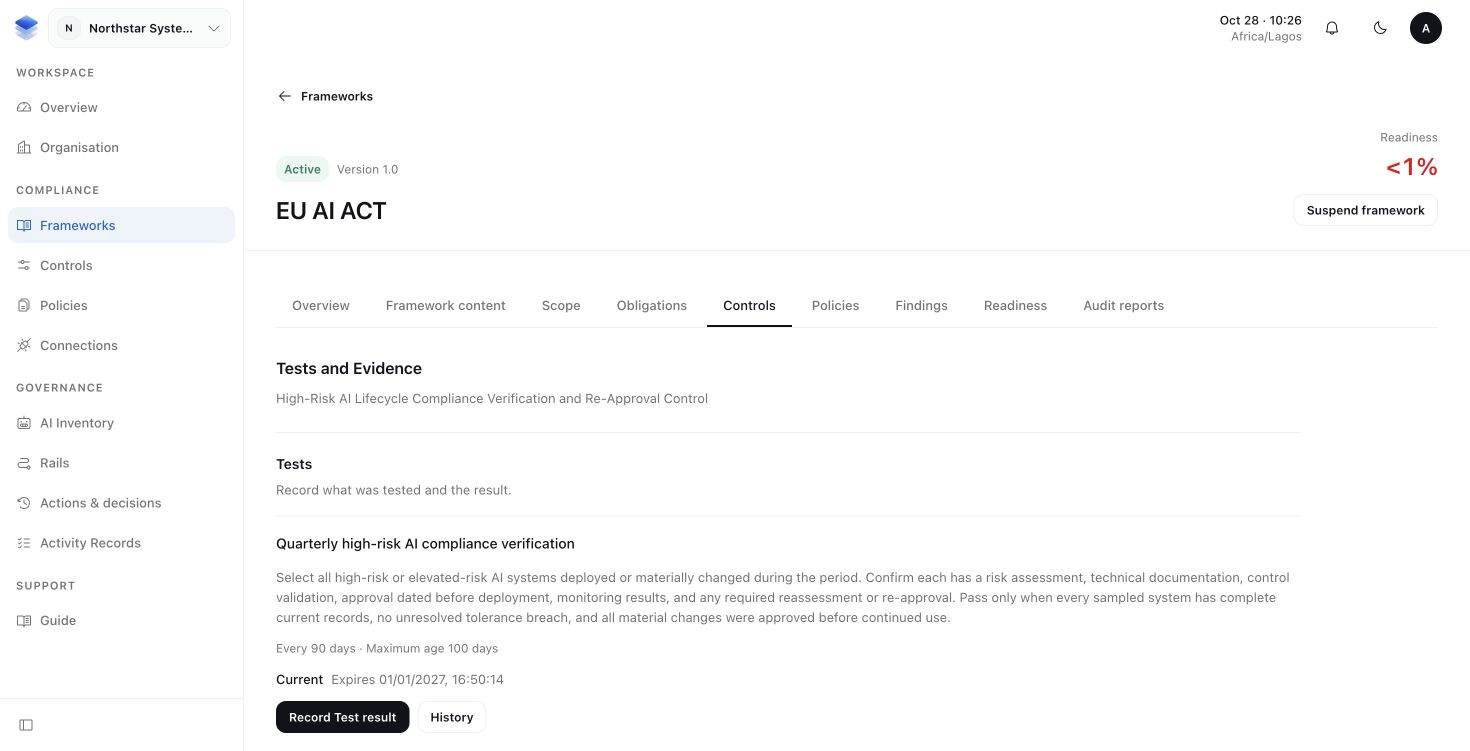
While editing the Control draft, choose Add test in Tests. Describe the procedure, what would count as a pass and which requests are included. Set the schedule and how long a result may be relied on. A check of one team's requests must not imply that the whole organisation was inspected.
2. State what proof is needed
In Required Evidence, use Add requirement in the same draft. Describe the material needed, its source, the period it must cover, how often it should be supplied and who should review it.
The requirement might ask for a Test result, an uploaded file or an eligible record from a connected system. Review and approve the Control version with these instructions before recording results against it.
3. Perform the check and record what you found
Inspect the requests and approvals for the period you defined. Choose Record Test result, then enter the period, the material inspected, the outcome and your explanation. Use History to inspect earlier checks.
Record a failure when the expectation was not met. If the material could not be retrieved or the check could not complete, record that problem rather than calling it a pass.
4. Submit the supporting Evidence
Use the submission action shown for the requirement, such as Select Test result or Upload Evidence. Submit the material for review. An authorised reviewer checks that it matches the requirement and period, then accepts or rejects it.
You should now have a saved check and the supporting material with its review state. Readiness can use eligible results and accepted proof; recording a Test result does not automatically accept it as Evidence. Continue with readiness and remediation to inspect the effect on a duty.
More about result names, freshness and history
A Test Run is one recorded check, including its period, inputs, outcome and explanation. An Evidence requirement describes the proof needed; an Evidence Record is one submission with its source and review history.
These records belong to the reviewed Control version. When a scoped Implementation defines a different practice, define its Tests and Evidence on that Implementation instead.
A later failed check cannot be hidden by an older pass. A successful result stops counting when its freshness expires—the date after which a new result is needed. Replacing Evidence keeps the previous submission and review in history rather than overwriting them.
Missing material needs a submission; rejected material needs the review reason addressed; stale material needs a new suitable period. Defining no Tests or Evidence requirements does not establish that a Control is healthy.
More about Evidence review
File Evidence requires review. If no eligible independent reviewer exists, AuthRail can accept eligible non-file Evidence under its recorded sole-operator fallback. Inspect the actual acceptance decision and reason; that fallback is not independent review.
A Test result required as Evidence still needs a separate Evidence submission and acceptance. Check source, period, freshness and review state when deciding which material to rely on. Inaccessible records need the right access; access failure is not a passing result.
More about connected records and Runtime proof
A Connection collects read-only records from a provider account your organisation has authorised. An Observation is a saved source fact collected at a particular time. It can supply an input to a Test or Evidence submission; it is not itself a passing Test.
Runtime Actions and execution reports can also support a suitably defined Test. The Test must specify the operations, period and required records. Observe-mode reports cannot establish enforcement, and a successful Action does not automatically satisfy the Control. See Runtime and Framework proof.
If collection fails, recover the input or replace it with eligible reviewed proof. Do not turn an unavailable provider record into a passing declaration.